

Key takeaways
Compensation is strategic. How you pay attorneys and other legal professionals drives culture, behavior, client service, and retention.
Models should fit your firm. Firms can choose or combine formula-based, lockstep, hybrid, performance-based, managed, and equal-share models, plus profit-sharing to match their goals and values.
Data makes compensation fairer. Reliable reporting on billables, collections, and profitability—through tools like 8am MyCase—is essential for transparent, defensible compensation decisions.
Compensation is one of the most powerful levers law firm leaders have to protect profitability and retain top talent—especially heading into 2026. The way you pay attorneys doesn’t just impact take-home pay; it shapes behavior, culture, client service, and long-term firm sustainability.
Today, compensation planning is more complex than simply rewarding billable hours. Lawyer and staff expectations around flexibility, transparency, and work-life balance have changed. Clients are pushing for alternative fee arrangements and greater efficiency. Hybrid work and new legal technology give firms better data on billables, collections, matter profitability, and individual performance than ever before. All of this puts pressure on traditional law firm compensation models and creates an opportunity for firms willing to rethink their approach.
This guide walks you through the most common law firm compensation models, including how they work, their pros and cons, and sample formulas you can adapt. You’ll also find practical strategies for modernizing compensation, aligning it with your firm’s values and goals, and using financial data and reporting tools to make fair, informed decisions about pay.
What are law firm compensation models?
Law firm compensation models are structured systems that determine how legal professionals are paid—typically through a mix of salary, bonuses, and profit sharing based on revenue, origination, and performance. These models look different across firms depending on size, culture, and practice areas, balancing factors like individual results, seniority, collaboration, and overall firm profitability to support both fairness and long-term growth.
Does every law firm need a compensation model?
Yes—every law firm needs a clear compensation model, even if it isn’t a complex formula on a spreadsheet. At minimum, you need a documented roadmap for how attorneys and staff are paid, promoted, and considered for bonuses, and that roadmap should align with your firm’s values, culture, and retention goals.
When expectations are clear—such as a small firm that moves from ad hoc raises to a defined performance-and-seniority model—lawyers are less likely to feel blindsided, disputes over pay decrease, and high performers have more reason to stay and invest in the firm’s long-term success.
Problems with traditional law firm compensation models
Traditional law firm compensation models generally center on seniority, origination fees, and billable hours, often using “eat what you kill” or lockstep approaches that were designed for a different market and workforce than the one firms face today. These older models may be simple and familiar, but they come with significant drawbacks:
Overemphasis on billable hours: Encourages quantity over quality, contributes to burnout, and may discourage efficiency or alternative fee arrangements.
Limited collaboration: “Eat what you kill” structures can create internal competition instead of teamwork, making cross-selling and knowledge sharing less likely.
Unfair recognition: Non-billable contributions—like mentoring associates, pro bono work, leading practice groups, or managing the firm—often go unrewarded.
Retention challenges: High performers and younger attorneys may leave for firms with clearer, fairer, and more holistic compensation frameworks.
Cultural imbalance: Prioritizing revenue over values can undermine morale, damage client experience, and weaken long-term firm health.
Lack of transparency: When associate and “of counsel” attorneys don’t understand how compensation decisions are made, mistrust and conflict can quickly follow.
Over time, these issues can fuel internal rivalries, increase turnover, and undervalue critical but non-billable work that keeps the firm stable and growing.
Common law firm compensation models
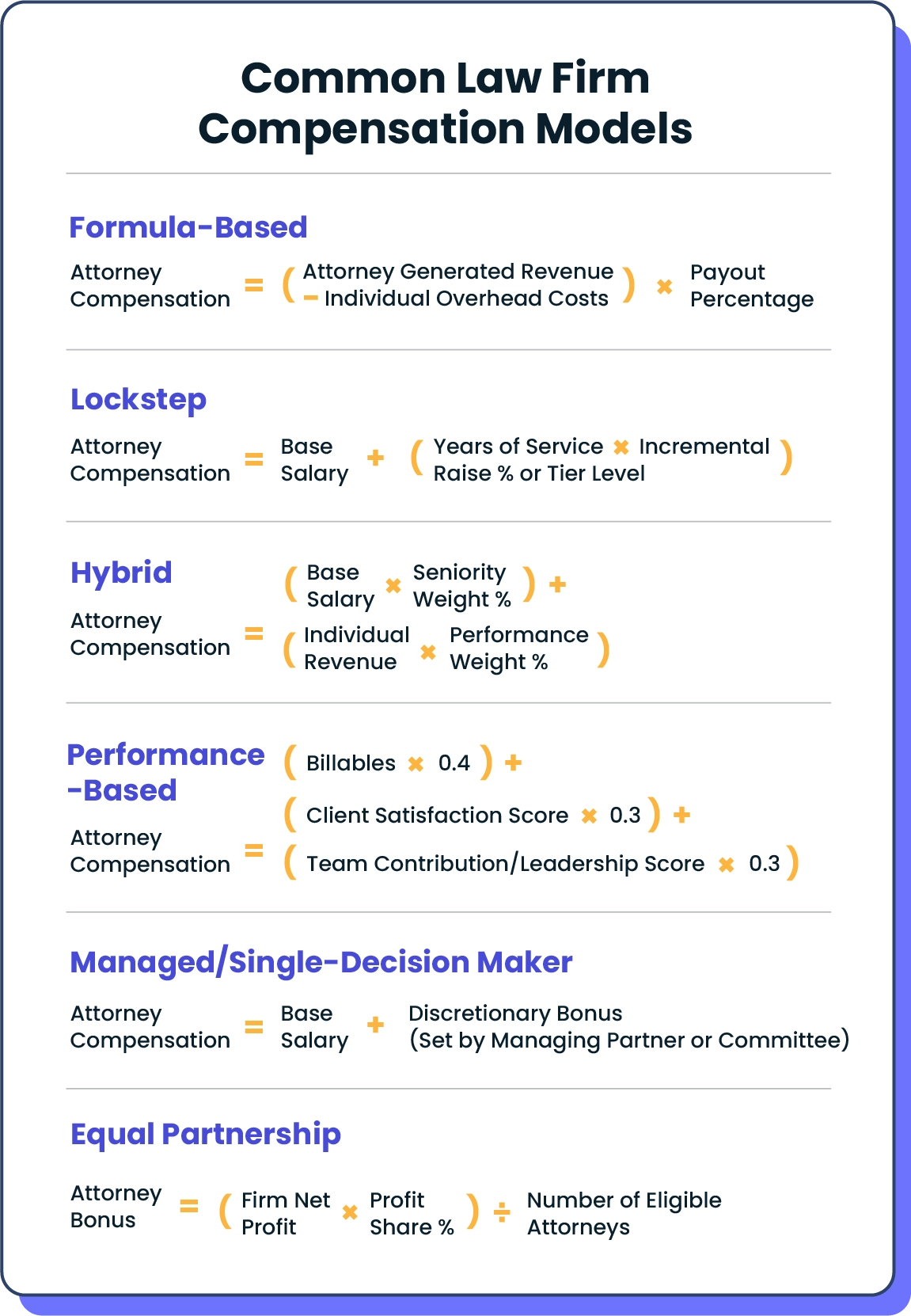
There’s no single law firm compensation formula that works for every practice. Instead, firms typically choose from a handful of common attorney compensation models—or combine them—to decide how profits, salaries, and bonuses are distributed. Below, we’ll walk through the main lawyer compensation models, how each works in practice, and example formulas you can adapt to your firm’s size, culture, and financial goals.
Model | Pros | Cons | Example formula |
Formula-based (EWYK) | Rewards productivity; clear link to effort; good for small firms | Ignores non-billable work; burnout risk; fosters competition | (Revenue – Overhead) × Payout % |
Lockstep | Promotes teamwork; loyalty; stability | Demotivates top performers; rewards tenure over results | Base + (Years × Raise %) |
Hybrid | Balances fairness and performance; flexible | Complex to manage; may feel unfair | (Base × Seniority %) + (Revenue × Performance %) |
Performance-based | Rewards broad KPIs; encourages leadership | Needs strong tracking; can feel subjective | (Billables × 0.4) + (Client Score × 0.3) + (Team Score × 0.3) |
Managed/committee | Flexible; holistic; quick adjustments | Risk of bias; needs transparency | Base + Discretionary Bonus |
Equal partnership | Simple, unified culture; low conflict | Frustrates high performers; hard to address the imbalance | Net Profit ÷ Partners |
1. Formula-based (“Eat what you kill”) model
Often referred to as the “eat what you kill” (EWYK) model, this traditional approach ties attorney compensation directly to individual revenue generation—typically measured by client origination, billable hours, and collections. Under this system, each attorney is primarily responsible for generating work, servicing clients, and covering their share of overhead, with pay rising or falling based on their own book of business. It’s a highly competitive model that strongly rewards productivity but can come at the expense of collaboration.
Pros:
Creates a clear link between individual effort, collections, and compensation
Rewards rainmakers and attorneys with strong business development skills
Can support rapid growth for small or entrepreneurial firms
Cons:
Overlooks non-billable contributions like mentoring, leadership, and firm management
Increases risk of burnout due to constant pressure to generate and bill work
Can foster silos and internal competition that undermine teamwork and knowledge sharing
Example formula: Attorney Compensation = (Total Revenue Generated by attorney – Individual Overhead Costs) × Payout Percentage
2. Lockstep model
In a lockstep model, attorney compensation increases predictably over time based on seniority and years of service rather than individual revenue alone. Attorneys share in a common profit pool, and pay moves up according to predefined “rungs” or tiers. The idea is to reward loyalty, encourage long-term commitment, and keep attorneys focused on what’s best for the firm and its clients—not just their own book of business.
Pros:
Promotes a team-first culture where attorneys are more likely to share work and support each other
Encourages long-term loyalty and stability, since compensation grows with tenure
Reduces internal competition and helps keep client service and firm reputation at the forefront
Cons:
Can demotivate high performers who feel their contributions outpace their compensation
Makes it harder to address underperformance if seniority is rewarded regardless of results
Risks include complacency and slower adoption of new ideas, technology, or business development efforts
Example formula: Attorney Compensation = Base Salary + (Years of Service × Incremental Raise % or Tier Level)
3. Hybrid model
A hybrid compensation model blends elements of formula-based (“eat what you kill”) and lockstep systems to balance fairness with performance. Attorneys typically receive a stable base tied to seniority or role, plus a variable component linked to individual revenue, origination, or other performance metrics. This modern approach aims to reward both long-term commitment to the firm and current-year contributions.
Pros:
Balances stability (seniority) with incentives for strong performance
Encourages collaboration while still recognizing rainmaking and individual effort
Gives firms flexibility to adjust weights as strategy, size, or market conditions change
Cons:
Can be more complex to design and administer than a single-model approach
Requires clear communication around how seniority and performance are measured
May still trigger disputes if attorneys feel the weights are unfair or outdated
Example formula: Attorney Compensation = (Base Salary × Seniority Weight %) + (Individual Revenue × Performance Weight %)
4. Performance-based model
With a performance-based model, attorney compensation is tied to a broader set of key performance indicators (KPIs) beyond just billable hours or origination. Firms may factor in client satisfaction scores, matter profitability, new business growth, leadership roles, mentoring, innovation, or contributions to firm culture. This modern approach is designed to align compensation with the firm’s strategic goals and the behaviors that drive long-term success.
Pros:
Rewards well-rounded performance, not just hours billed or revenue generated
Encourages leadership, mentoring, and business development that benefit the whole firm
Easier to connect pay decisions to clearly defined, measurable objectives
Cons:
Requires strong data, consistent tracking, and agreed-upon KPIs
Can be perceived as subjective if the evaluation criteria aren’t transparent
Takes time to design, refine, and communicate
Example formula: Attorneys Compensation = (Billables × 0.4) + (Client Satisfaction Score × 0.3) + (Team Contribution/Leadership Score × 0.3)
5. Managed or single-decision maker model
Managed compensation models have a managing partner, executive committee, or compensation committee set pay based on a mix of quantitative metrics (like billables, collections, and originations) and qualitative factors (such as leadership, mentoring, or strategic contributions). Rather than relying on a rigid formula, decision-makers review performance data and make judgment calls within agreed parameters. This approach often sits between traditional and hybrid models—more flexible and holistic, but highly dependent on trust and transparency.
Pros:
Allows for nuanced decisions that account for both numbers and non-billable contributions
Flexible enough to adapt to changing firm priorities, markets, or roles
Can quickly reward or correct performance without overhauling the entire model
Cons:
Perceived risk of favoritism or bias if the criteria aren’t clearly defined and communicated
Requires strong governance, documentation, and communication to maintain trust
May leave some unclear on exactly how their compensation is determined
Example formula: Attorney Compensation = Base Salary + Discretionary Bonus (Set by Managing Partner or Committee)
Bonus or profit-sharing model examples
Many firms layer a law firm profit-sharing plan or bonus pool on top of their base attorney compensation model. In these plans, attorneys receive additional income from a shared pool of firm profits or collective performance bonuses. A thoughtful law firm bonus structure can reward firm-wide results while still recognizing individual contributions.
Two common approaches include:
Equal distribution (simple model): Used when attorneys share equally in firm performance regardless of seniority or origination.
Attorney Bonus = (Firm Net Profit × Profit Share %) ÷ Number of Eligible Attorneys
Performance-weighted distribution: Rewards attorneys proportionally based on defined metrics (e.g., billables, collections, client satisfaction, or leadership contributions).
Attorney Bonus = (Firm Net Profit × Profit Share %) × (Individual Performance Score ÷ Total Performance Scores)
These models can be customized to reflect your firm’s priorities—such as emphasizing client service, profitability, or contributions to firm management—while keeping the underlying formulas clear and predictable.
Key strategies to improve compensation models
It can be a major lift to replace your law firm’s compensation model. Whether you’re using a lockstep system, an individual formula-based model, a hybrid, or something more unique, you can still make meaningful improvements by tuning how your current structure works in practice. The strategies below also provide a strong foundation if you’re designing a new model from scratch.
1. Highlight your law firm’s mission and values
Start by clarifying your firm’s mission, vision, and core values, then make sure your compensation decisions reflect them. For example, if your values emphasize client service, collaboration, or access to justice, those behaviors should show up in bonus criteria and promotion decisions—not just in marketing materials. When attorneys see that bonuses and raises align with the firm’s stated values, it reduces internal friction and promotes a more cohesive culture.
2. Reward client-centered performance
New business matters, but not at the expense of client experience. Build client-centered metrics into your bonus discussions, such as:
Positive online reviews or testimonials
Net Promoter Score (NPS) or similar satisfaction measures
Referrals from existing clients
Tying a portion of compensation to client satisfaction helps shift the focus from “hours billed” to “value delivered,” which supports long-term relationships and reputation.
3. Ensure market-competitive salaries
Regularly review salary and bonus ranges against market data for your region, firm size, and practice areas. Attorney and staff pay should reflect:
Role and level of responsibility
Local and practice-specific market benchmarks
The firm’s financial health and growth targets
Market-competitive compensation supports recruitment, reduces turnover, and signals respect for the work your team performs—especially for younger attorneys who have more options and transparency than ever before.
4. Encourage collaboration and innovation
Compensation models that only reward individual performance can unintentionally create silos. Counter this by building in rewards for collaboration and innovation, such as:
Cross-selling work between practice groups
Leading internal initiatives (e.g., improving intake, collections, or client communication)
Participating in regular brainstorming sessions on topics like “improving payment collections” or “enhancing client service”
You can even recognize participation and impact from these efforts in bonus discussions or performance reviews, signaling that sharing ideas and supporting colleagues is part of the job, not extra credit.
5. Leverage technology for transparency
Modern firms have access to rich data on time entries, billing, collections, and matter profitability. Use your practice management, billing, and reporting tools to:
Track key metrics tied to your compensation model
Create clear dashboards or reports
Explain how decisions connect to objective data
When lawyers can see how their billables, collections, client feedback, and contributions impact compensation, the process feels fairer, and disputes are easier to manage. This sets the stage for the next step: using a platform like 8am MyCase to centralize financial data and make compensation planning more transparent and informed.
Use 8am MyCase to simplify financial reporting
Even with a well-designed compensation model, it’s hard to make fair decisions if you don’t have accurate, up-to-date financial data. That’s where MyCase comes in. With built-in billing, payments, case management, and financial reporting, firm leaders can see exactly how time, fees, and collections are performing across matters and practice areas—without exporting multiple spreadsheets.
With MyCase, you can:
Track billable time and utilization by attorney to see who is meeting targets
Monitor billing and collections in real time, including aging legal invoices and write-offs
Review matter and client profitability to understand which work is driving results
Run practice group reports that tie directly into your compensation formulas
Keep an eye on payment plans and online payments, so cash flow is easier to forecast
Strengthen client communication with secure messaging, shared documents, and real-time updates
When compensation discussions are backed by clear, consistent data, it’s easier to explain decisions, adjust formulas, and maintain trust.
Try MyCase free for 10 days to see how transparent financial insights improve compensation planning.
Law firm compensation model FAQs
About the author

Mary Elizabeth Hammond is a Senior Content Strategist and Blog Specialist for 8am, a leading professional business solution. She covers emerging legal technology, financial wellness for law firms, the latest industry trends, and more.